
Introduction
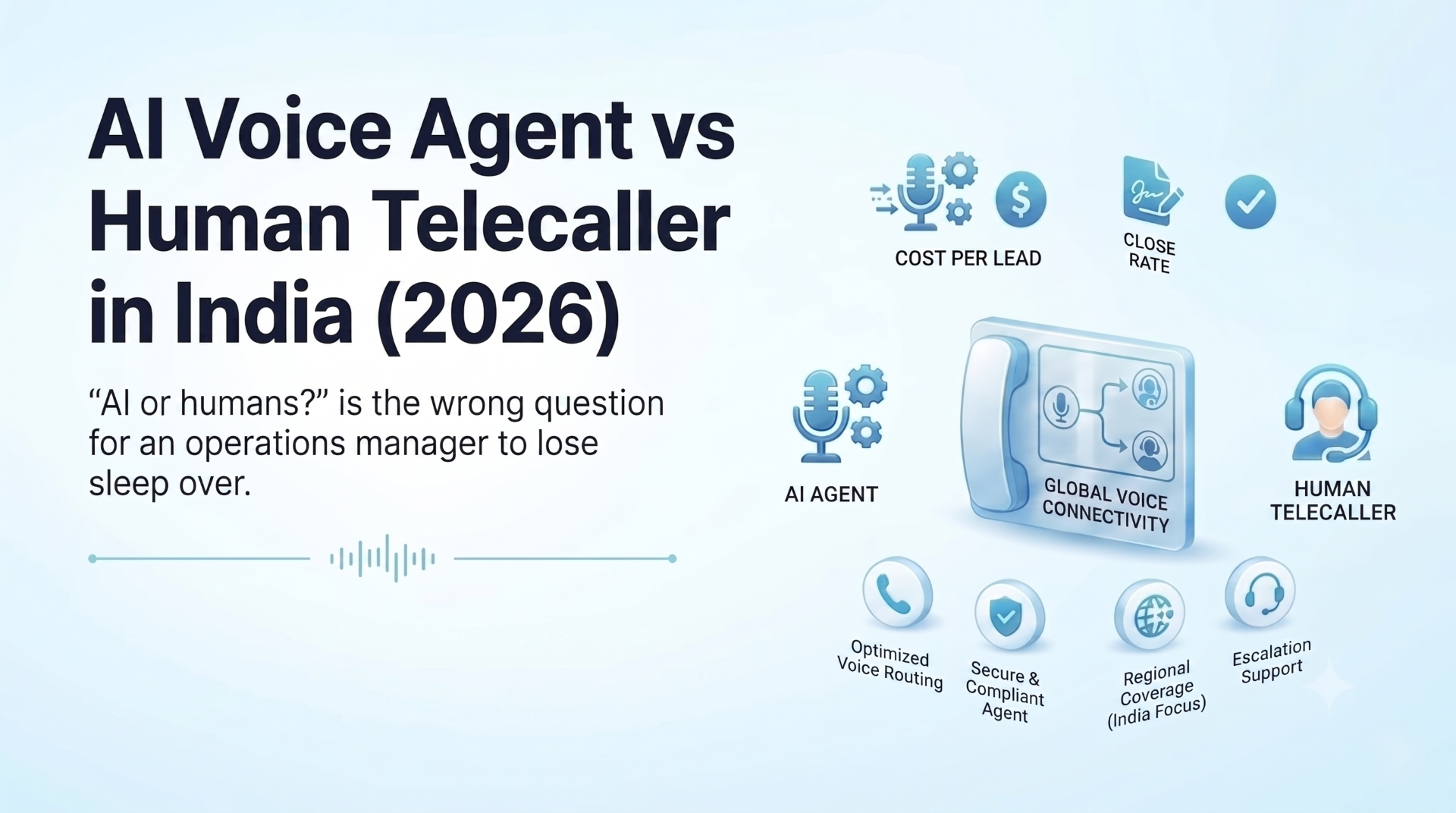
Most of the AI-versus-humans noise misses the point. Neither side replaces the other cleanly. What you actually need to know is where each one earns its keep, and how to divide the work between them. This piece compares AI voice agent vs human telecaller on cost, on the jobs each does best, and on the setup most Indian teams settle into once the dust clears.
It matters because telecalling is one of the biggest line items in any Indian sales or support operation, and call center automation in India has moved from experiment to default. Real estate, lending, healthcare, edtech, and D2C brands are all asking the same thing: keep hiring telecallers, or put a voice agent on the phones? The honest answer is rarely "all of one." It is a split, and getting it right is the difference between a tool that pays for itself in a month and one that quietly drains budget.
Cost: the gap is real, but read it carefully
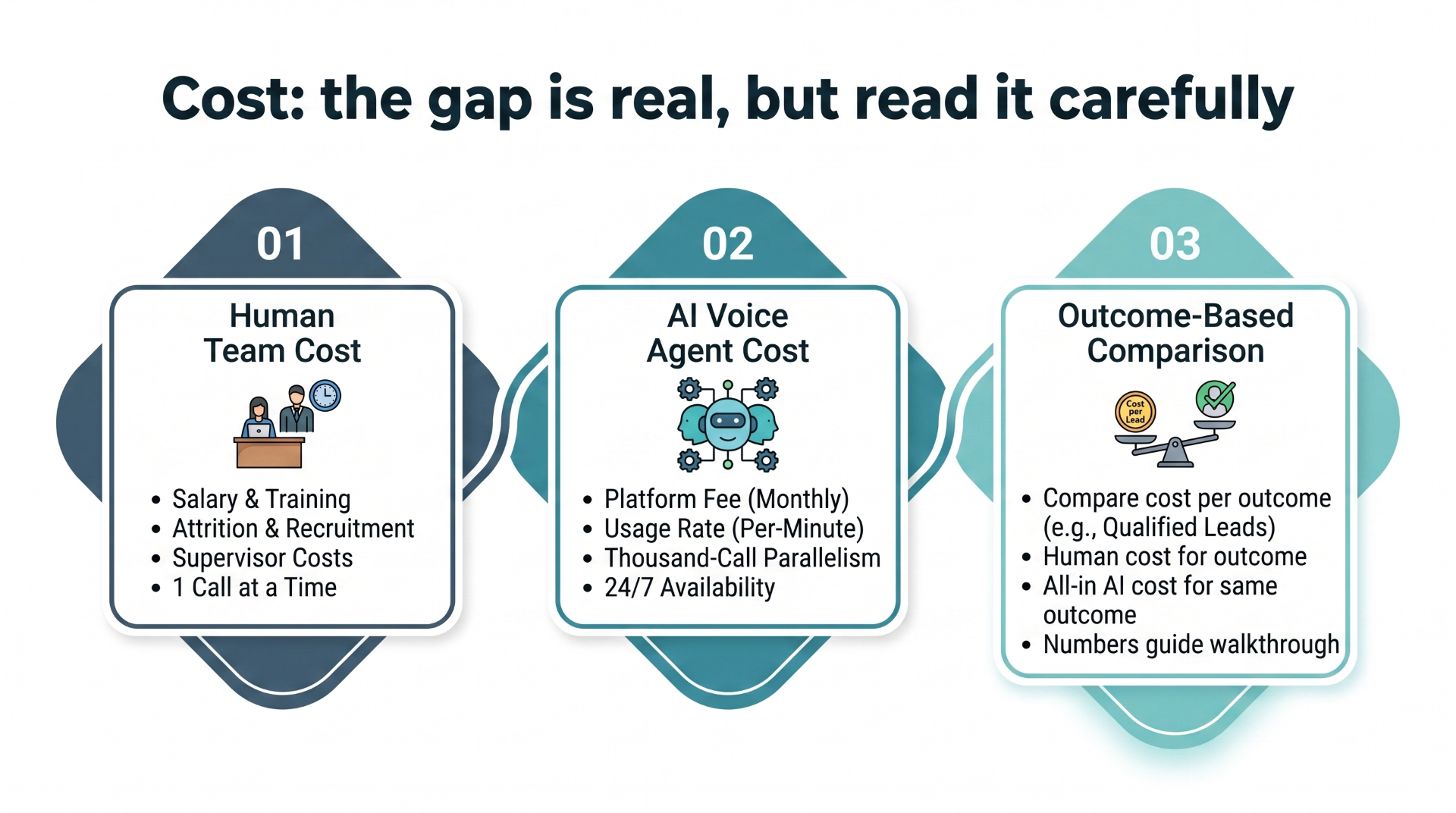
A vendor will tell you AI replaces your telecalling team. A telecaller will tell you AI can't do what they do. Both have a pitch to protect, and the truth sits somewhere in the middle: AI voice agents and human telecallers are good at genuinely different jobs. A human comes with salary, training, attrition, a supervisor, and a hard ceiling of about one call at a time across an eight or nine hour shift. An AI agent comes with a monthly platform fee plus per-minute usage, runs thousands of calls at once, and doesn't go home at 6pm. The mistake almost everyone makes is comparing a salary to a per-minute rate. Compare cost per outcome instead. Work out what your human team spends to produce, say, 150 qualified leads a month, then put the all-in AI cost for those same 150 leads next to it (our pricing guide walks through the numbers).
The hidden costs are what tilt this human vs AI calling comparison. A telecaller's salary is only the visible part. Add recruitment, weeks of ramp before they're productive, a team lead for every eight or ten agents, seats, headsets, and the dialler licence. Then add the single biggest tax in Indian call centres: attrition. Telecalling routinely sees turnover well above most other roles, so you are forever re-hiring and re-training, and every new joiner starts slow and off-script again. An AI agent has none of that churn, the script you approve on day one is delivered on call ten thousand, with no Monday-morning dip and no resignation letter.
When you do the cost comparison properly, the per-outcome maths usually breaks down like this:
- Human telecaller: fixed monthly cost whether call volume is high or low, plus the overheads above, capped at roughly 60-80 dials per agent per day.
- AI voice agent: largely variable cost that tracks usage, scales to thousands of simultaneous calls, and stays flat per minute whether you run 500 calls or 50,000.
That difference is why AI calling ROI looks so strong for high-volume, repetitive campaigns, and why it looks far weaker for low-volume, high-touch selling where a person's judgment carries the deal.
Where AI genuinely wins
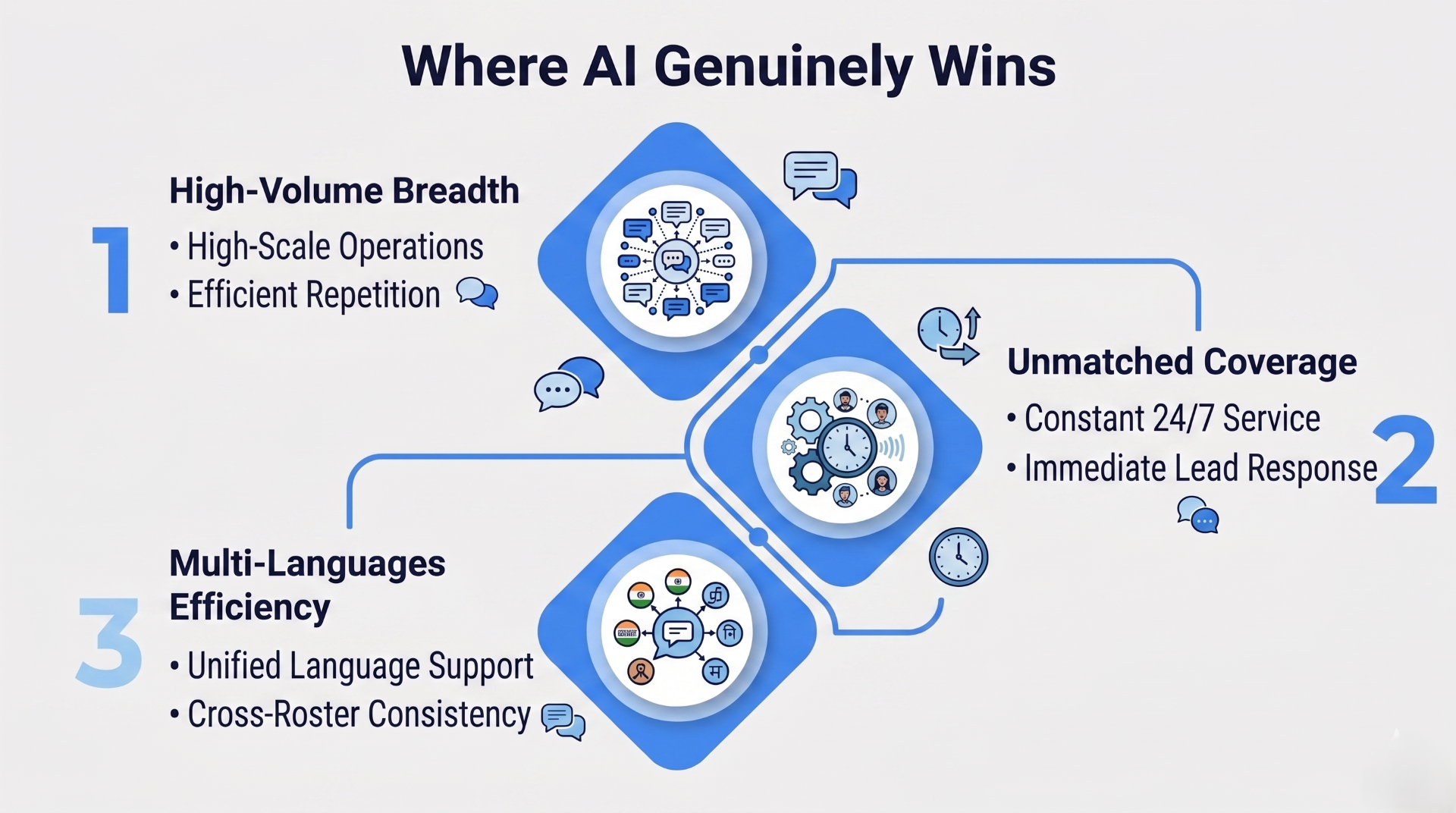
AI wins on breadth. It is built for volume and repetition: reminders, confirmations, first-touch qualification across thousands of contacts without flagging on the five-hundredth call. It gives you coverage no roster can match, picking up at 2am, on a Sunday, in the middle of a festival rush. The hundredth call is as patient and polite as the first. It rings a new enquiry back within seconds, every single time, which is usually where leads are won or lost. And it handles a Hindi caller, then a Tamil one, then a Marathi one, without you staffing three separate teams.
Consistency is the underrated advantage here. A human telecaller has good days and bad days; the pitch sharpens after lunch and flattens by the last hour of the shift. An AI agent delivers the exact approved message, with the same compliance disclosures and the same objection handling, on every call. For regulated work like EMI reminders or lead qualification, that uniformity is a genuine risk-reduction win, not just a convenience. The classic high-volume use cases where AI clearly beats a human telecaller include:
- Appointment and EMI reminders, payment-due nudges, and delivery confirmations.
- First-touch lead qualification and instant callback on web enquiries.
- Feedback and CSAT surveys at scale after a service or purchase.
- After-hours, weekend, and festival-season overflow that no roster can staff economically.
If your bottleneck is reach and speed-to-lead rather than persuasion, this is squarely AI's territory, and it is where most Indian businesses see their fastest return.
Where humans genuinely win
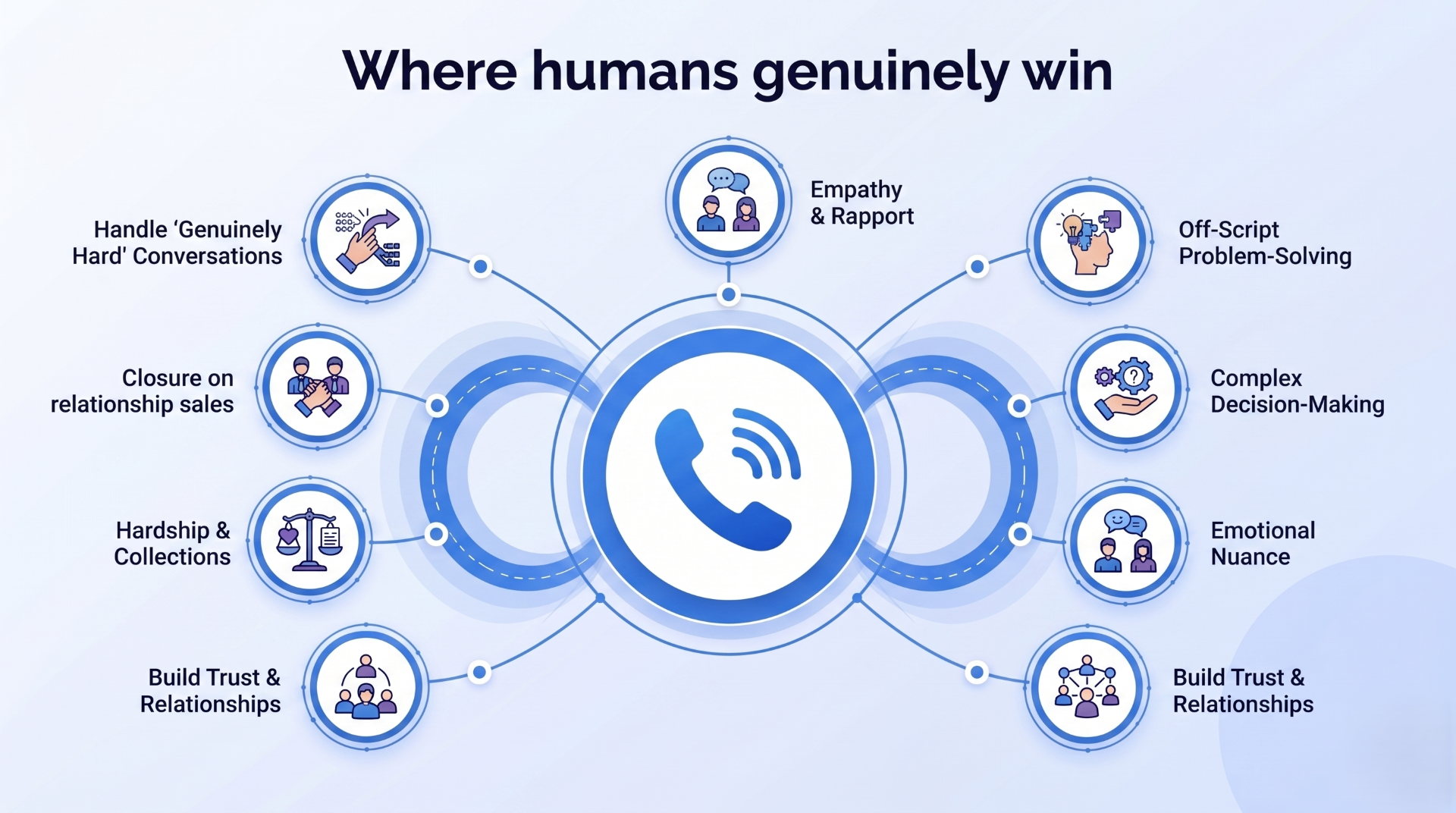
Humans win on depth. Hand them the conversations that are complex, emotional, or high-stakes: an upset customer who is one bad reply from leaving, a hardship case on a collections call, a big-ticket negotiation where the tone of voice matters as much as the offer. They are the ones who can problem-solve off-script, build the rapport that closes a relationship sale, and read the 10 to 20% of calls that simply need a person on the line. The split is clean once you see it. AI does the same well-defined thing reliably at scale; humans take the handful of conversations that are genuinely hard.
The reason is straightforward: humans bring empathy, improvisation, and accountability that no script anticipates. When a borrower explains a job loss, or a high-value buyer raises an objection that wasn't in any playbook, a skilled telecaller can change tack, offer reassurance, and bend the conversation toward a solution. That judgment is exactly where a person earns far more than their cost. The trap is using that expensive judgment on calls that never needed it, asking a closer to read out reminder scripts all day is the most common and costly mistake in Indian telecalling teams. Keep your people for relationship selling, escalations, and the deals where a human voice genuinely moves the number.
The model that actually works: hybrid
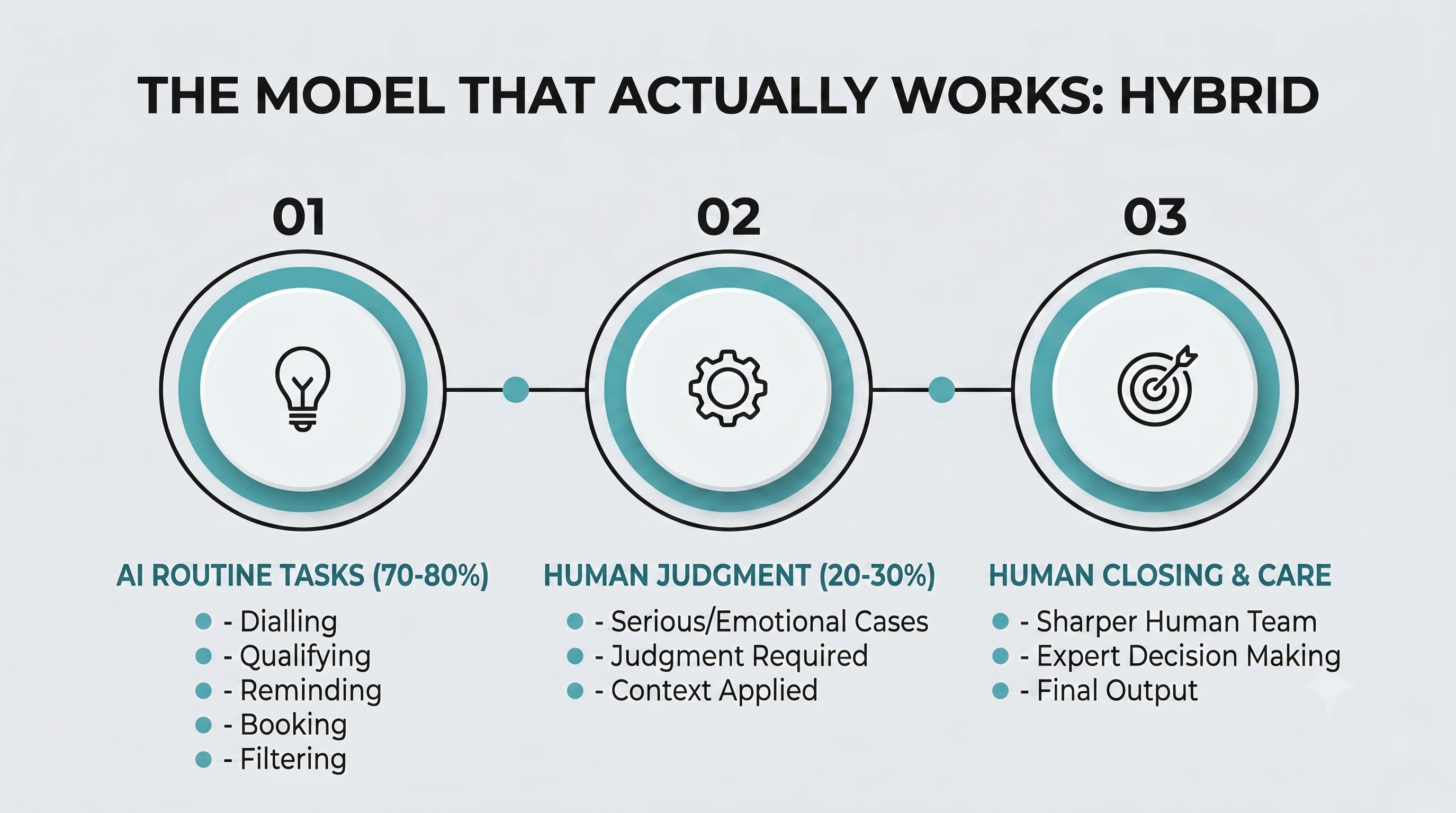
The setup with the best return isn't AI or humans. It's AI, then humans. The agent takes the routine 70 to 80%: dialling, qualifying, reminding, booking, filtering. The serious or emotional 20 to 30% gets passed to your team with the context already gathered, so your best people only pick up the calls where their judgment actually changes the result. What you end up with is a smaller, sharper human team handling closing and care, sitting on top of an AI layer that grinds through the rest. You aren't firing anyone. You're just no longer paying skilled people to read out reminder scripts.
In practice the hybrid model is a relay, not a replacement. The AI agent dials the list, weeds out wrong numbers and not-interested contacts, captures intent, and books the genuinely warm leads straight into a human's calendar, with notes attached. The telecaller's day stops being a grind of 200 cold dials to find ten worthwhile conversations; instead they walk into ten pre-qualified conversations with context already in hand. Connect rates climb, morale improves, and attrition often falls because the work is more interesting. For BFSI teams running collections and EMI follow-ups, this hand-off pattern is especially powerful, our guide for BFSI covers how the routing works in regulated workflows, and industry pages show the split for real estate, healthcare and more.
What customers actually think
The objection that stalls most teams is "won't people hate talking to a bot?" People hate a bad bot, the robotic, laggy, can't-understand-my-accent kind. They don't hate a good one. An agent that answers on the first ring, speaks their language, and actually sorts out their problem beats sitting in a hold queue for a human most days of the week. The job is to match the agent to the right calls: send it where the customer wants speed and availability, and keep humans for the moments where empathy is the whole point.
The quality bar has moved fast. Native-audio agents now handle Indian accents, code-switching between English and a regional language mid-sentence, and natural turn-taking, without the lag that made older IVR systems so hated. Two things keep perception positive: be upfront that it's an automated assistant, and build a fast escalation to a human the moment the caller asks or the call turns sensitive.
How to choose for your business
You don't need a grand strategy to start, you need a sorting exercise. Audit your last month of calls and tag each type by how repetitive and scriptable it is, and how high the emotional or financial stakes are. Repetitive, low-stakes work (reminders, confirmations, surveys, first-touch qualification) is your AI column; complex, high-stakes, relationship-driven work is your human column. Anything in between is a hand-off candidate for the hybrid model. A few practical pointers:
- Lead with volume. The higher and more repetitive the call volume, the stronger the AI calling ROI, so pilot AI on your biggest, most scriptable campaign first.
- Measure the right thing. Track cost per outcome and connect rate before and after, not vanity metrics like total calls dialled.
- Protect the human edge. Redeploy freed-up telecallers to closing and care rather than cutting them, that is where the conversion gains compound.
- Start small, then scale. Prove the split on one workflow, get the script and hand-off right, then roll it across teams.
Get the routing right and you stop paying for human vs AI calling as an either-or, and start buying the strengths of both. See pricing to model the numbers for your own volume.
Where this leaves you
Stop framing it as AI or humans. Ask which calls belong to which, and the hybrid answer beats either extreme on both cost and conversion.
Here is the practical first step. List your call types and sort them into two columns: repetitive and scriptable, or complex and relationship-driven. Move the first column to an AI agent and keep the second with your people. Track cost per outcome for each, before and after, so the decision rests on numbers rather than opinion. Then put the human hours you free up back into closing and customer care, where they pay. 9278.io is built to be that AI layer for Indian businesses, with native-audio agents in 15+ languages and a clean handoff to your team. Build your first agent, or compare the best platforms first.
Ready to put a voice agent on your phones?
Native-audio AI agents in 15+ Indian languages, on Jio/Airtel/BSNL/Vi, live in hours.
Build your first agent