
Introduction
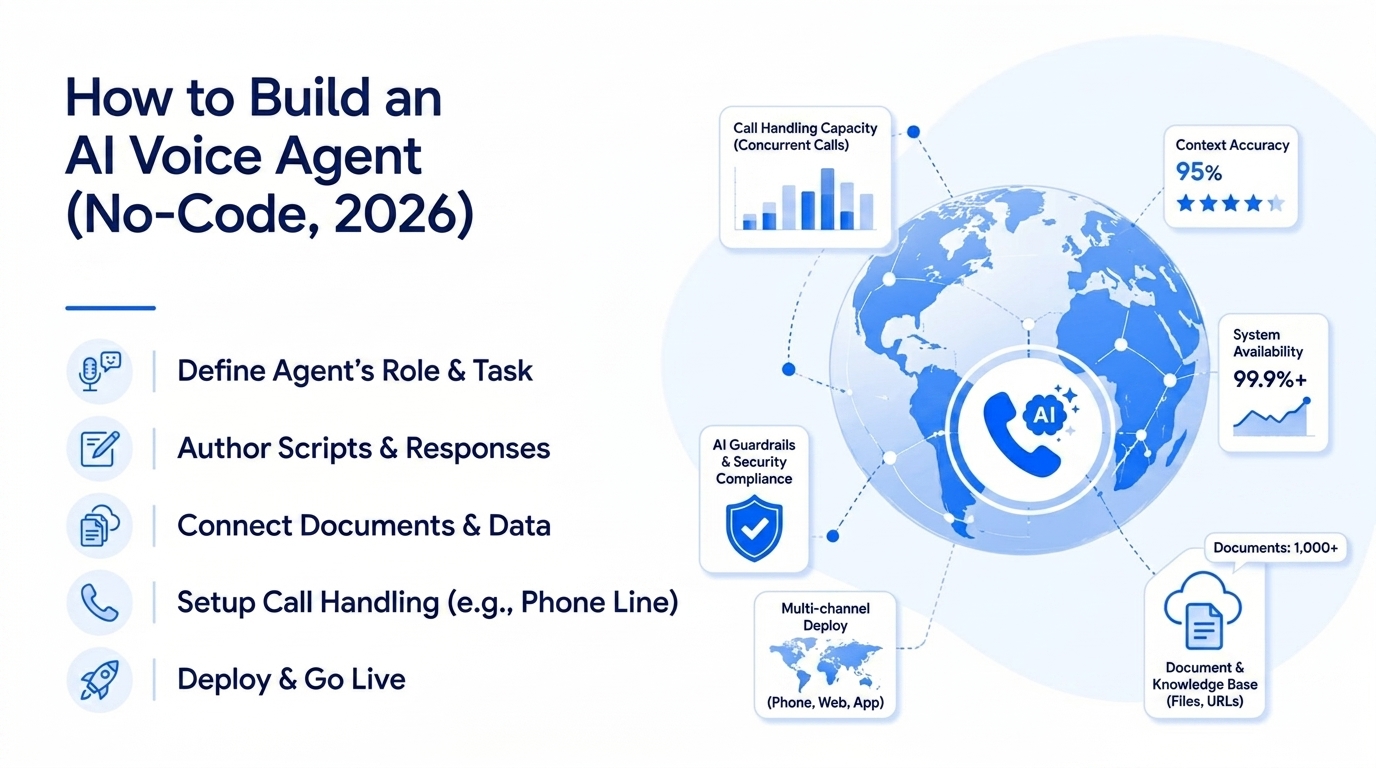
This used to be an engineering project. Today it is closer to onboarding a new hire: you tell the agent who it is, what to ask, and where the lines are, and it does the job. The seven steps below take you from a blank brief to a compliant agent making real calls in India, and you won't write a single line of code along the way.
The shift that made this possible is the modern no-code voice agent platform. Instead of stitching together a speech-to-text engine, a language model, a text-to-speech voice and a telephony provider yourself, the platform bundles all four behind a simple interface. You describe behaviour in plain language, upload the documents the agent should know, and the heavy lifting (latency tuning, interruption handling, call routing) is handled for you. That is why a small team in Pune or Coimbatore can now build an AI calling agent without hiring a single developer. The catch is that the thinking still matters: a no-code tool removes the wiring, not the need to design the job well.
Step 1-2: define one job, then brief it
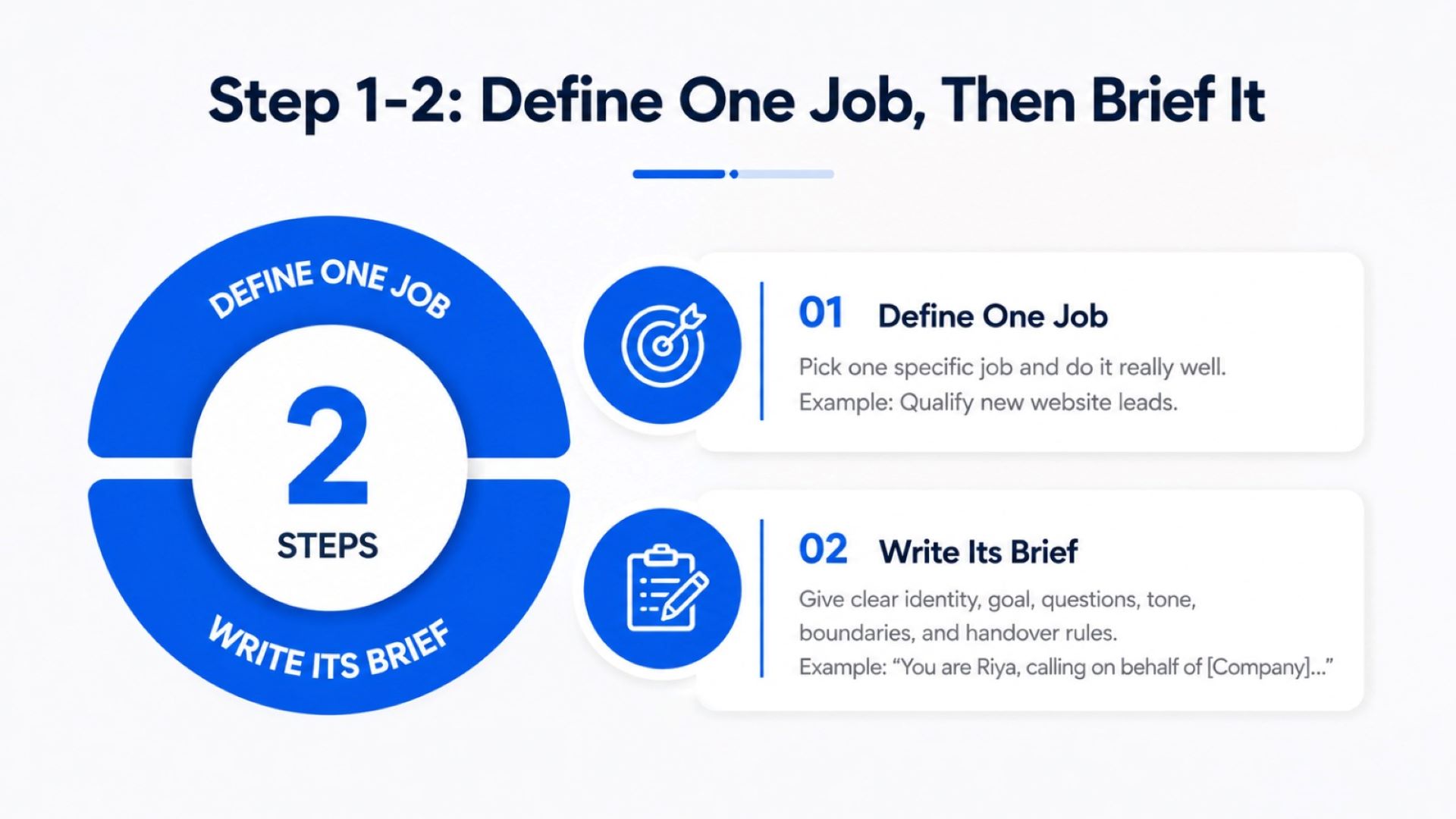
Start by deciding what the agent does, and resist the urge to make it do everything. Pick one job: "call every new website lead and qualify them," say, or "answer inbound calls after hours and book appointments." One job, done well, beats a clever agent that flails across three. Then write its brief in plain English, the way you'd sit a new junior telecaller down on their first morning. Give it an identity ("You are Riya, calling on behalf of [company]"), a goal, the exact questions to ask, the tone and language to use, and clear boundaries: what to do when the call goes off-script, and the moment to hand over to a human. Be specific. Use examples. A vague brief produces a vague agent.
A strong brief reads like a short script with guardrails rather than a paragraph of vague intentions. The most useful ones cover five things:
- Identity and opening line — who the agent is and the first sentence it speaks, including which language to greet in (many Indian callers respond best to a Hindi or regional opener, then a switch to English on cue).
- The one outcome — book a slot, confirm an order, or capture three qualifying answers. Name it explicitly.
- The exact questions — in order, with the follow-ups for likely replies.
- Tone and pace — warm and unhurried for a clinic, crisp for a logistics confirmation.
- Boundaries and handoff — what it must never promise, and the trigger phrase that sends the call to a human.
If you would not hand the same instructions to a new employee and expect them to succeed on day one, the agent will not either. Treat the brief as the most important hour of the whole build.
Step 3-4: give it knowledge and tools
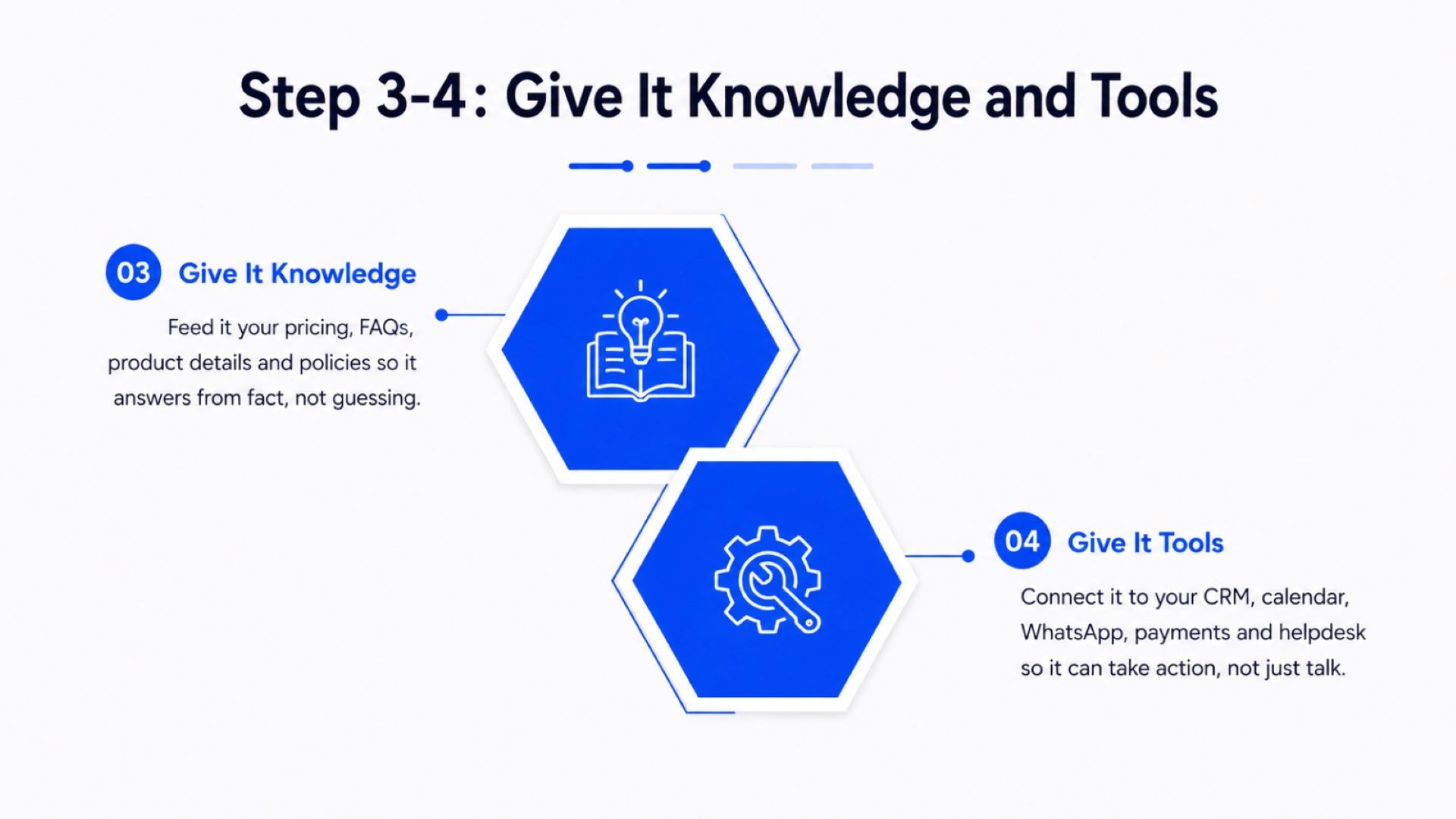
An agent is only as good as what it knows. Feed it your pricing, FAQs, product details and policies so it answers from fact instead of guessing; the platform sorts out the retrieval (the RAG plumbing) for you. Then wire it into the systems your team already lives in: the CRM to log leads, the calendar to book slots, WhatsApp to fire off confirmations, a payment link, your helpdesk. That's the difference between an agent that can talk and one that can actually get something done.
A RAG knowledge base (retrieval-augmented generation) is what keeps the agent honest. Rather than relying on the model's general training, the platform fetches the relevant lines from your own documents at the moment the caller asks, so "What's your refund window?" is answered from your policy, not from a guess. To get the most out of it, keep source material clean and current: one fact in one place, dated where it matters, and pruned of anything outdated. A stale price list is worse than no price list, because the agent will quote it with total confidence. Re-upload when your offers or hours change, and the answers update with them. For the tools side, start with the two or three integrations that close the loop on your one job, and add the rest later once the core flow is reliable.
Step 5: test in a sandbox before going live
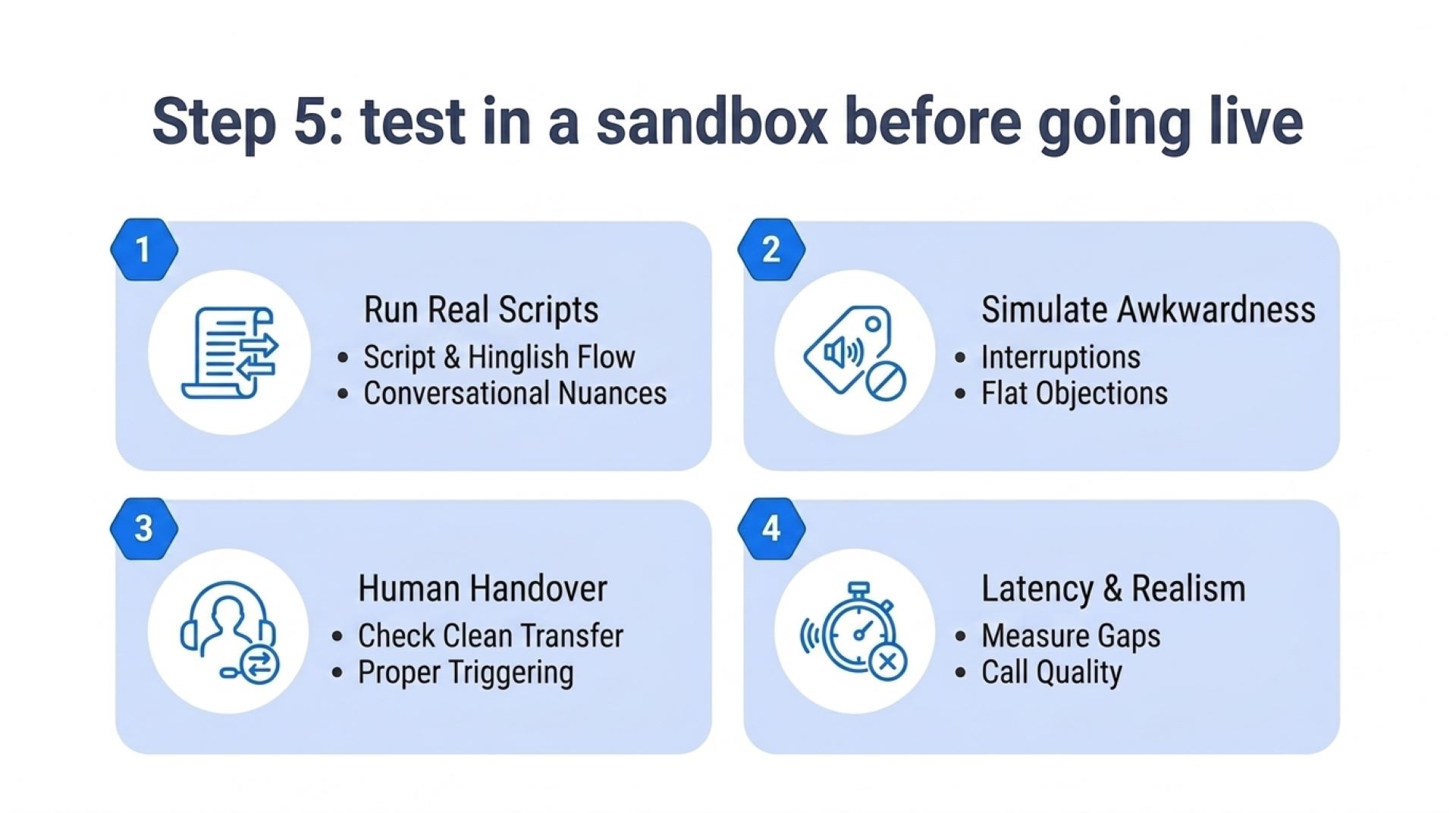
Don't let your customers be the first people your agent talks to. A decent platform gives you a sandbox for exactly this: run your real scripts through it, including the messy Hinglish ones, and throw the awkward stuff at it. Interrupt it mid-sentence. Hit it with "let me think" pauses and flat objections. Check that it hands over to a human cleanly when it should, and listen hard for latency, because long gaps are what make callers realise they're talking to a machine. Compare versions, patch the weak spots, and only push it live once it genuinely sounds right.
Build a short list of test calls that mirror your real customers and run every version against it. For an Indian audience that means code-switching mid-sentence, regional accents, background noise from a busy street or shop, and callers who answer a question before you have finished asking it. Note where the agent stumbles: a question it misheard, a fact it could not find in the knowledge base, a moment it should have handed off but ploughed on. Because edits take minutes, you can fix and re-test in the same sitting. The goal is not perfection on call one; it is an agent that fails gracefully, falls back to a human cleanly, and never invents an answer it cannot support.
Step 6: get a number and go live, compliantly
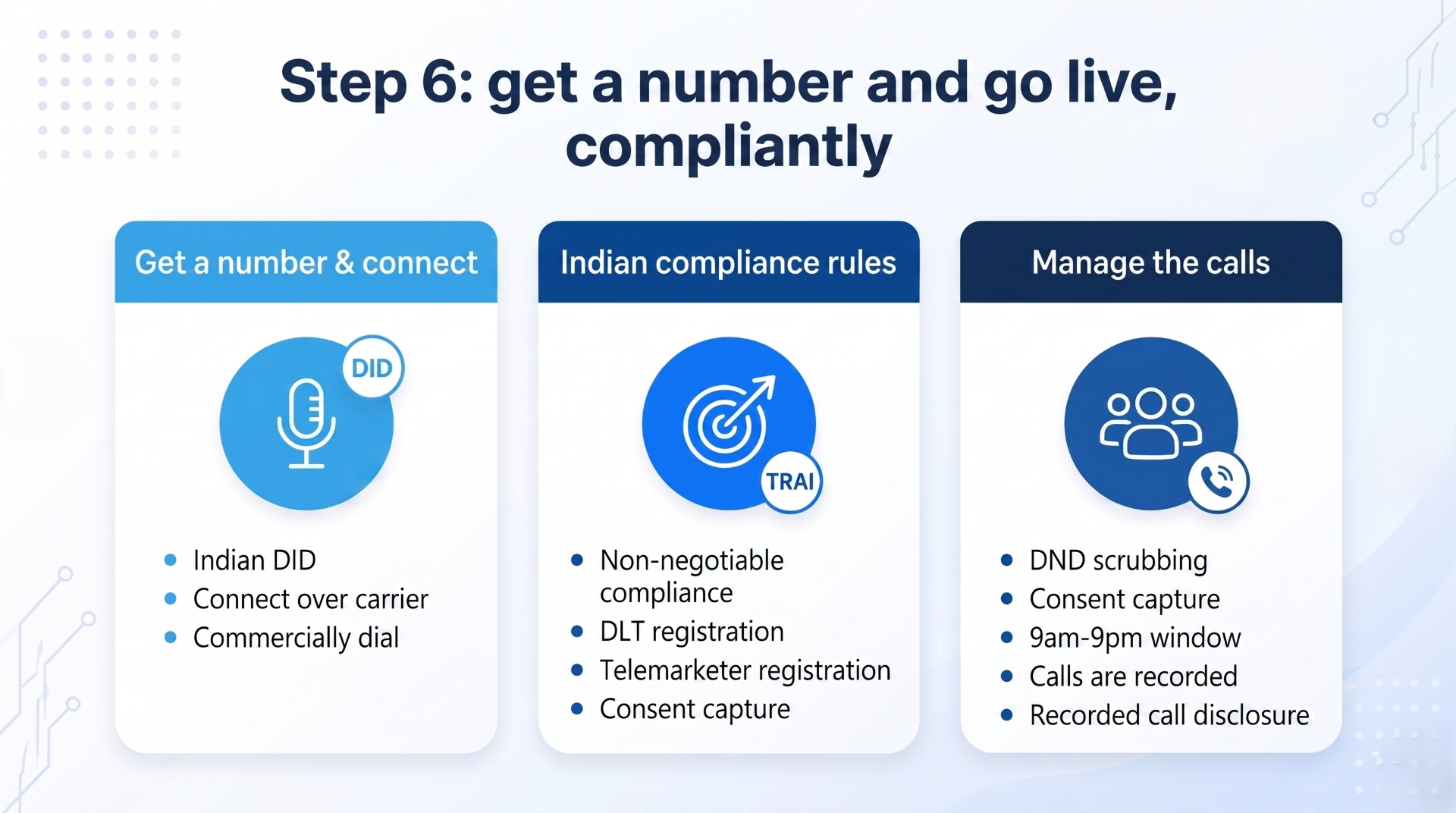
Get yourself an Indian DID number (or port the one you already use) and connect it over a carrier. Then comes the part nobody in India gets to skip. Before you dial real customers commercially, compliance is non-negotiable: complete your DLT and telemarketer registration, switch on DND scrubbing and consent capture, stay inside the 9am-9pm window for promotional calls, and disclose that calls are recorded. Our TRAI compliance guide walks through the lot. Cut corners here and you can get your lines disconnected, which ends the project faster than any bug ever will.
To go live compliantly, fold these requirements into the build rather than treating them as a final checkbox. Register your sender header and content templates on the DLT platform, scrub your calling list against the DND registry before every campaign, and keep an auditable record of consent for each number you dial. The same care extends to data: under the DPDP Act you are responsible for how recordings and personal details are stored and used, so confirm your platform handles them securely. Different sectors carry their own rules too, which is why teams in regulated spaces such as healthcare and finance should map requirements before launch. Done properly, compliance is not a brake on the project; it is what lets you scale without your numbers being flagged.
Step 7: launch small, measure, improve
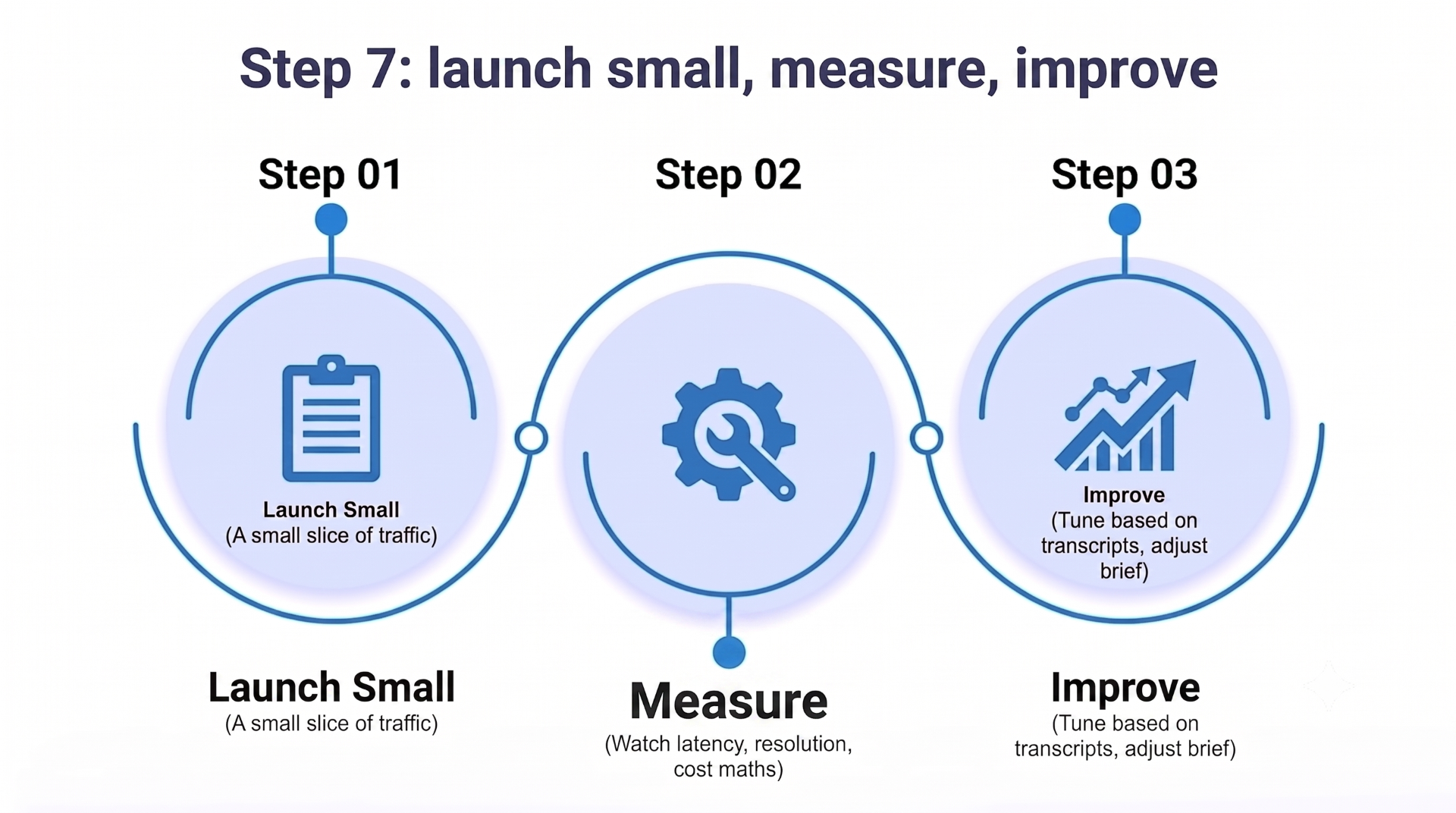
Point it at a slice of your traffic first, not the whole funnel. Read the transcripts, watch what actually happens on the calls, and tune from there. Keep an eye on latency, resolution rate, and cost per outcome (our pricing guide breaks down the rupee maths). Adjust the brief and the knowledge based on the calls in front of you, then open the tap wider. Since an edit takes minutes rather than a sprint, the agent keeps getting sharper as you learn what your callers really ask.
How long does it really take, and what does it cost?
The honest answer is that the build itself is fast and the readiness around it is what sets the clock. A single, well-scoped agent can be briefed, given its knowledge base and tested in a sandbox inside a few hours. What usually adds days is the paperwork that has nothing to do with the agent: getting a number provisioned and completing DLT and telemarketer registration. Sort those in parallel while you write the brief, and a same-day launch on an Indian line is realistic. The running cost is driven mainly by call minutes and the integrations you switch on, not by a big upfront engineering bill; our cost guide for India and our pricing page lay out the numbers so you can model it against your call volume.
Conclusion
Keep your first agent narrow, brief it properly, test it until it stops surprising you, and build compliance in from the start rather than bolting it on at the end. That's most of the job. The rest is avoiding a handful of traps that catch nearly everyone the first time round.
The first is scope creep: trying to make one agent handle sales, support, and collections at once. Keep it to a single job until that job is rock solid. The second is a thin brief. If you wouldn't hand the same instructions to a new employee and expect them to succeed, the agent won't either. The third is skipping the sandbox and letting live customers do your testing for you. And the fourth, the one that's specific to India, is treating compliance as a last-day checkbox instead of part of the build: get DLT registration, DND scrubbing, and consent sorted before the very first real call. 9278.io is built around this exact flow. Build your first agent, or hear a live demo before you do.
Ready to put a voice agent on your phones?
Native-audio AI agents in 15+ Indian languages, on Jio/Airtel/BSNL/Vi, live in hours.
Build your first agent