
Introduction
For most Indian businesses, the language a customer hears in the first few seconds decides whether they stay on the line. A polished English script can quietly cost you conversions in markets where buyers think, negotiate and make decisions in Hindi. This guide walks through how Hindi and Hinglish voice agents work, where a regional language voice AI earns its keep, and how to tell a natural one from a robotic one before you pay for it.
The short version: a Hindi voice bot for business is not a translated English bot. The two are built differently, and the gap shows up the moment a real caller opens their mouth. For a broader primer, see our guide to what an AI voice agent is.
What a Hindi voice agent is
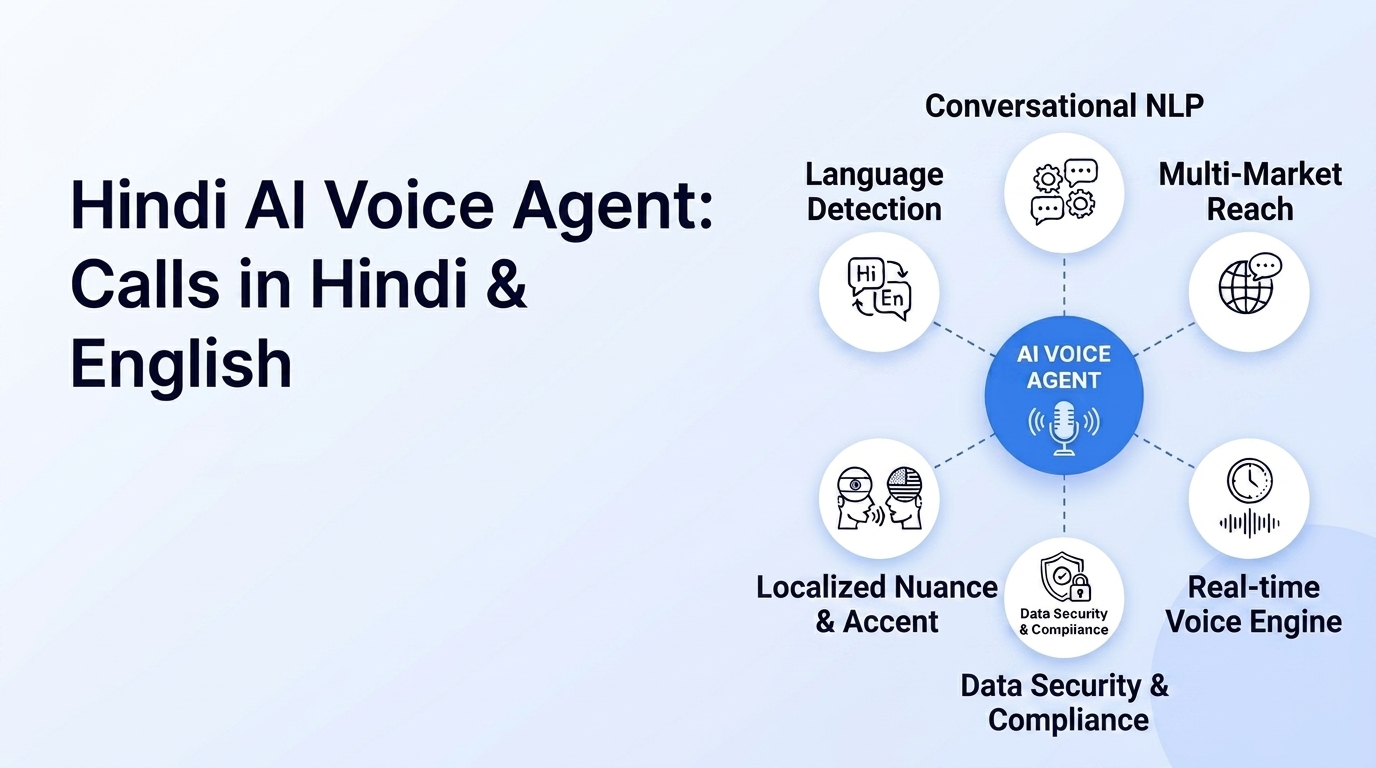
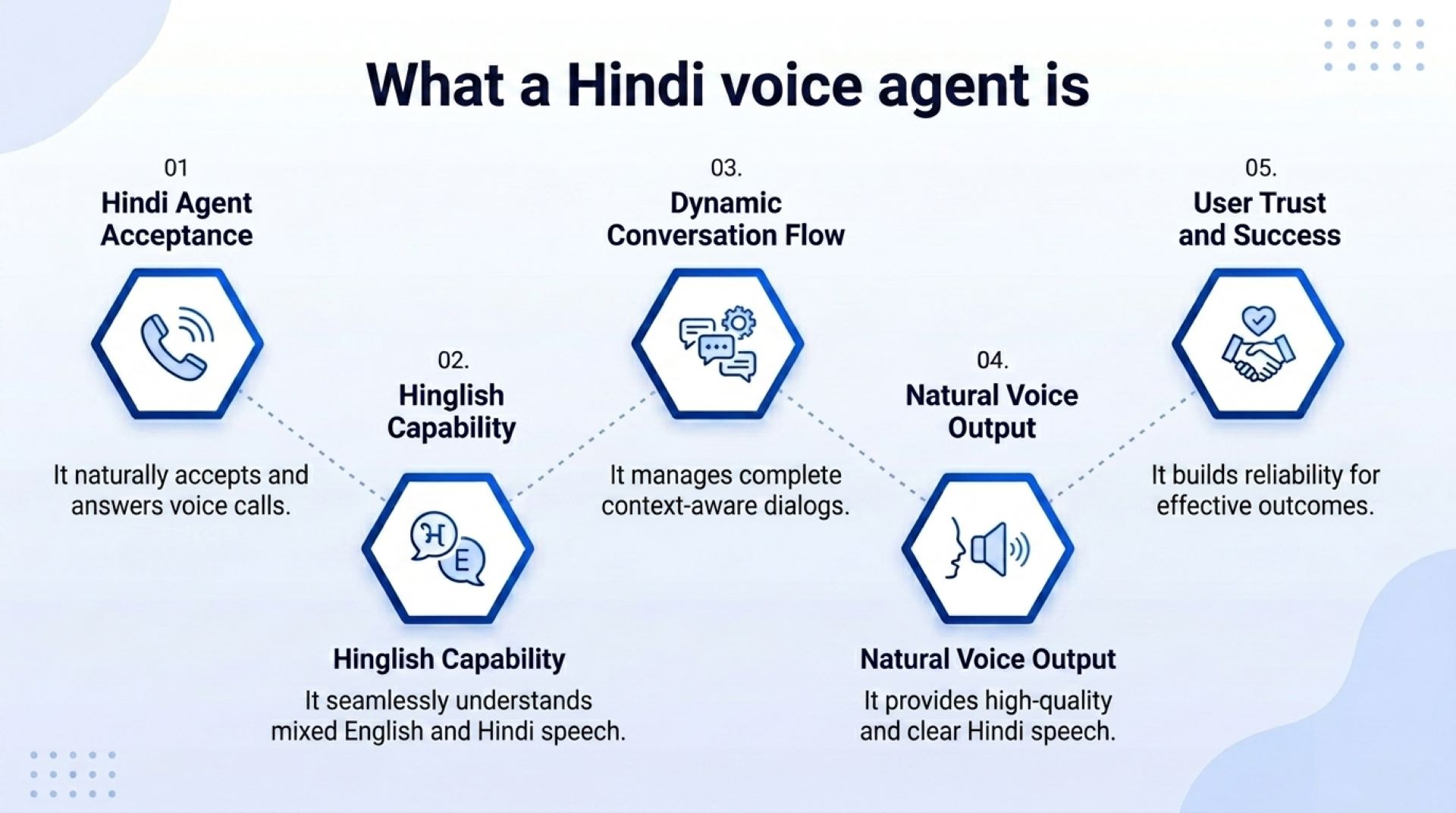
A Hindi AI voice agent is software that holds a full phone conversation in Hindi and, just as importantly, in Hinglish, the Hindi-English blend most Indians actually speak. It answers an inbound call, follows a customer who flips languages mid-sentence, and replies in a voice that doesn't sound like a 2010-era IVR. That last point is everything. It's the difference between a tool people trust and one they hang up on.
Under the hood, a capable Hinglish voice bot does three jobs at once: it listens and transcribes speech as it arrives, works out what the caller actually wants regardless of which language they used, and generates a spoken reply in a natural Indian voice. Older stacks bolt three separate systems together, which adds delay and breaks pronunciation at every handoff. Newer audio-native models do far more of this in one pass, which is a big reason they sound more human. The practical takeaway for a buyer is simple: ask how the system is built, because architecture is what you actually hear on the call.
It also helps to be clear about what a Hindi voice agent is not. It is not a recorded IVR menu with "press 1 for Hindi," and it is not a chatbot reading a script aloud. A real agent improvises within guardrails: it answers an unexpected question, re-asks when it mishears, and stays on task even when the caller wanders. That flexibility, in the caller's own language, is what makes it feel like a trained agent rather than a machine.
Why Hindi and Hinglish are harder than they look
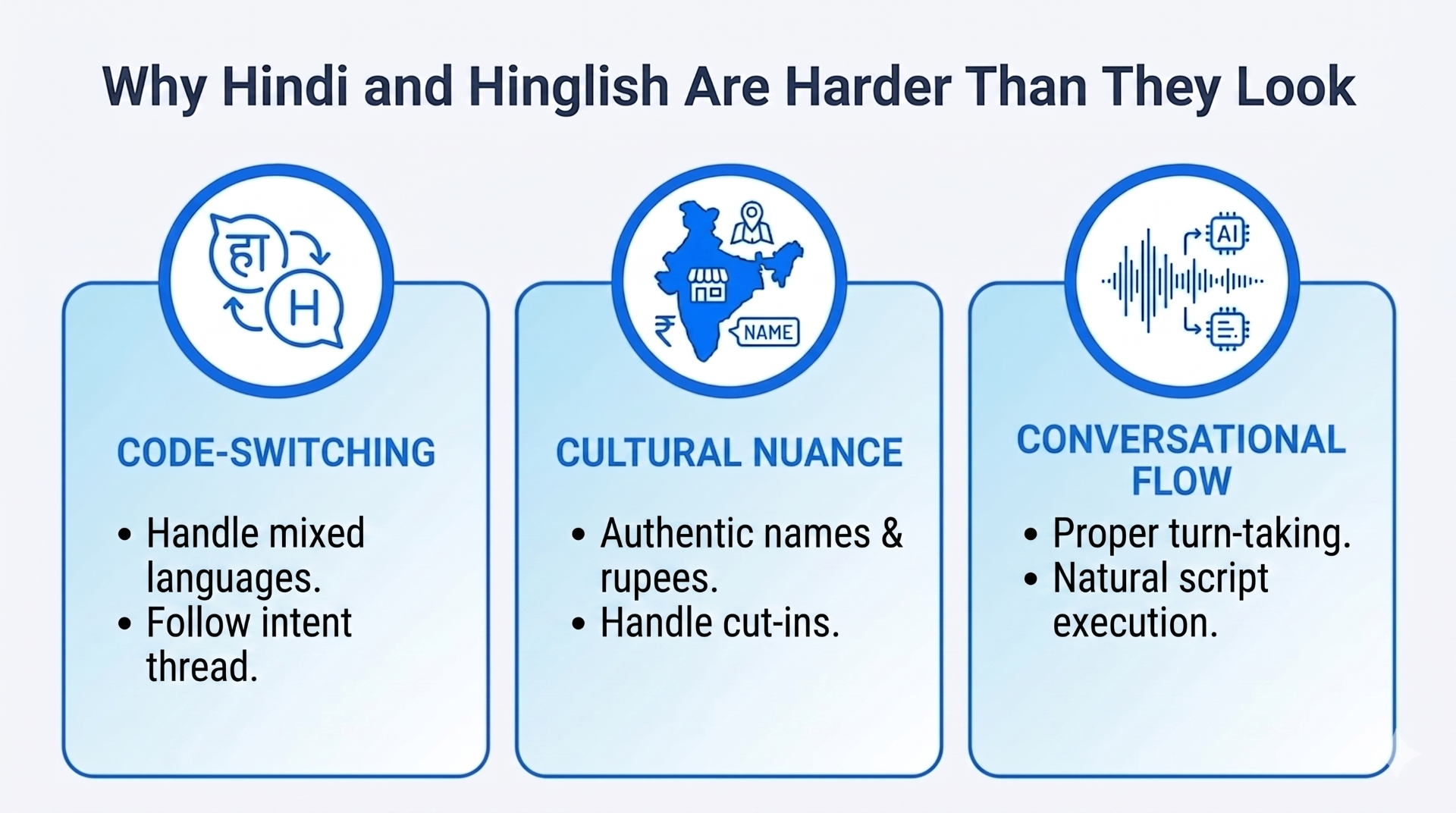
Listen to a real call and you'll hear something like: "Haan ji, main interested hoon, but pehle pricing batao, EMI option hai kya?" One sentence, two languages, numbers in English, intent in Hindi. To handle that, an agent has to track the code-switching without dropping the thread, say Indian names, places and rupee amounts the way a local would, and judge turn-taking properly, knowing when the caller has finished and recovering when they cut in. Better still, it should sense the caller's comfort language and shift to it on its own. So here's the buyer's test that matters: don't ask "do you support Hindi?" Ask the vendor to run your own Hinglish script and listen to whether it sounds like a person.
The specific things that trip up weaker systems are worth naming, because they are exactly what you should listen for in a demo:
- Code-switching mid-sentence. Many bots can do Hindi or English but stutter when the two collide in one breath, which is the norm in real Indian speech.
- Numbers and money. "Pachattar hazaar" versus "seventy-five thousand," EMI tenures, and dates are where robotic readers fall apart and lose trust instantly.
- Names and places. A natural agent pronounces "Bhubaneswar," "Lakshmi" or a housing-society name correctly instead of mangling it letter by letter.
- Interruptions. Real callers cut in. The agent should stop talking, listen, and pick the thread back up without restarting its whole script.
There is also a cultural layer that pure accuracy misses. Tone, politeness markers like "ji," and the rhythm of an Indian sales or support call matter as much as vocabulary. A system that nails grammar but sounds curt or overly formal still feels off to a customer in Lucknow or Jaipur. The best Indian languages call automation gets the warmth right, not just the words.
Where a Hindi voice agent earns its keep
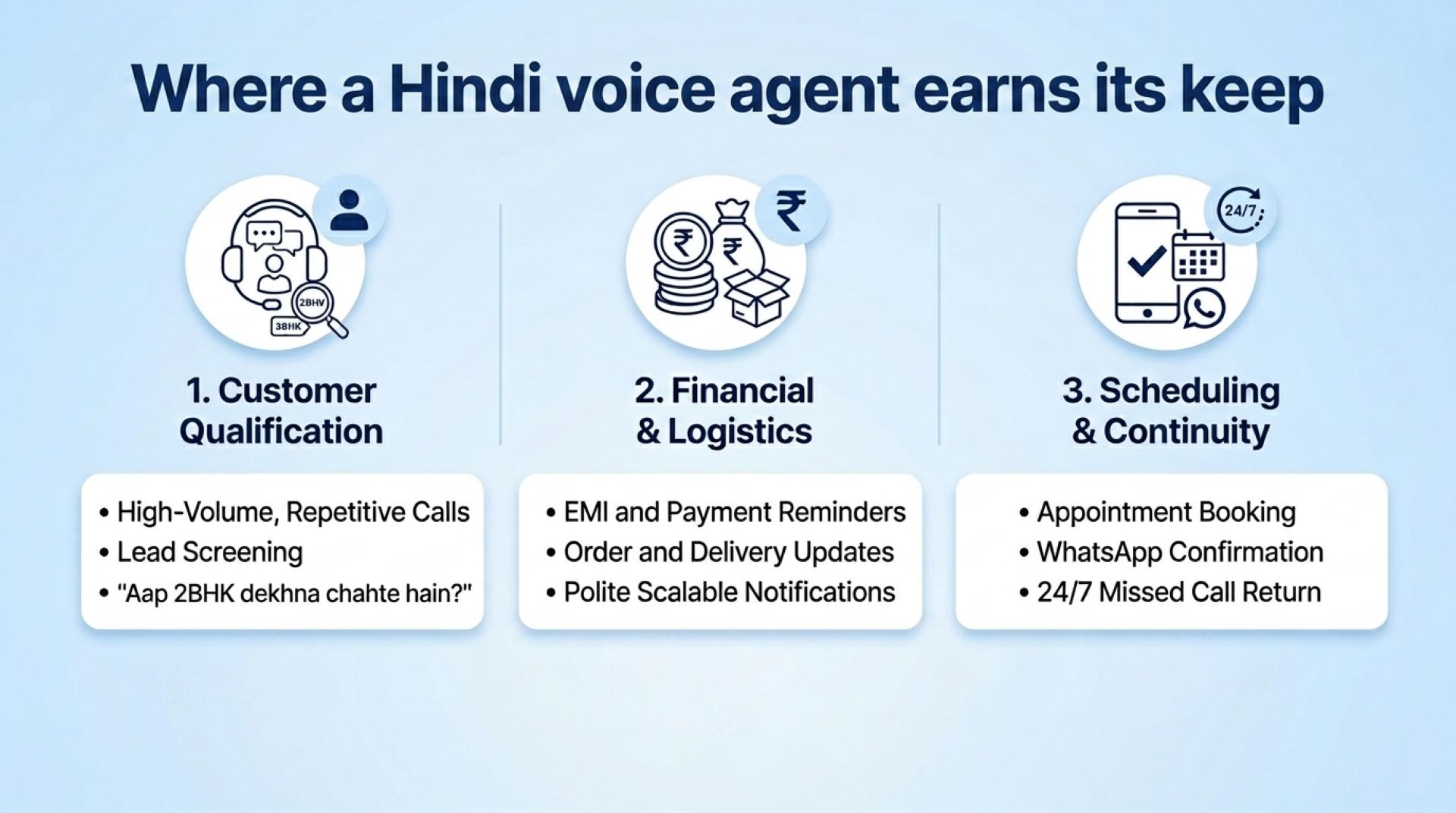
The calls that pay off first are the high-volume, repetitive ones your team dreads. Lead qualification ("Aap 2BHK dekhna chahte hain ya 3BHK?"). EMI and payment reminders delivered politely, at any scale you need. Appointment booking and reminders with a WhatsApp confirmation. Order and delivery updates. And every missed call returned within minutes, day or night.
The pattern across all of these is the same: the conversation is predictable, the volume is high, and a human agent gets bored or inconsistent doing it for the hundredth time. A voice agent does call number one and call number ten thousand identically, never forgets to ask the qualifying question, and logs every answer straight into your CRM. That consistency is often worth more than the labour saved, because it means cleaner data and fewer leads slipping through the cracks at 9pm on a Sunday.
Sectors feel this differently. In real estate, the win is qualifying site-visit intent before a salesperson spends a Saturday on it; our deep dive on AI voice agents for real estate covers that flow. In lending and collections, it is gentle, compliant EMI follow-ups at scale. In healthcare and clinics, it is appointment reminders that cut no-shows. In e-commerce and logistics, it is delivery confirmation and address verification calls that would otherwise tie up a whole team. You can see more of these by industry on our industries page.
Beyond Hindi: the regional reality
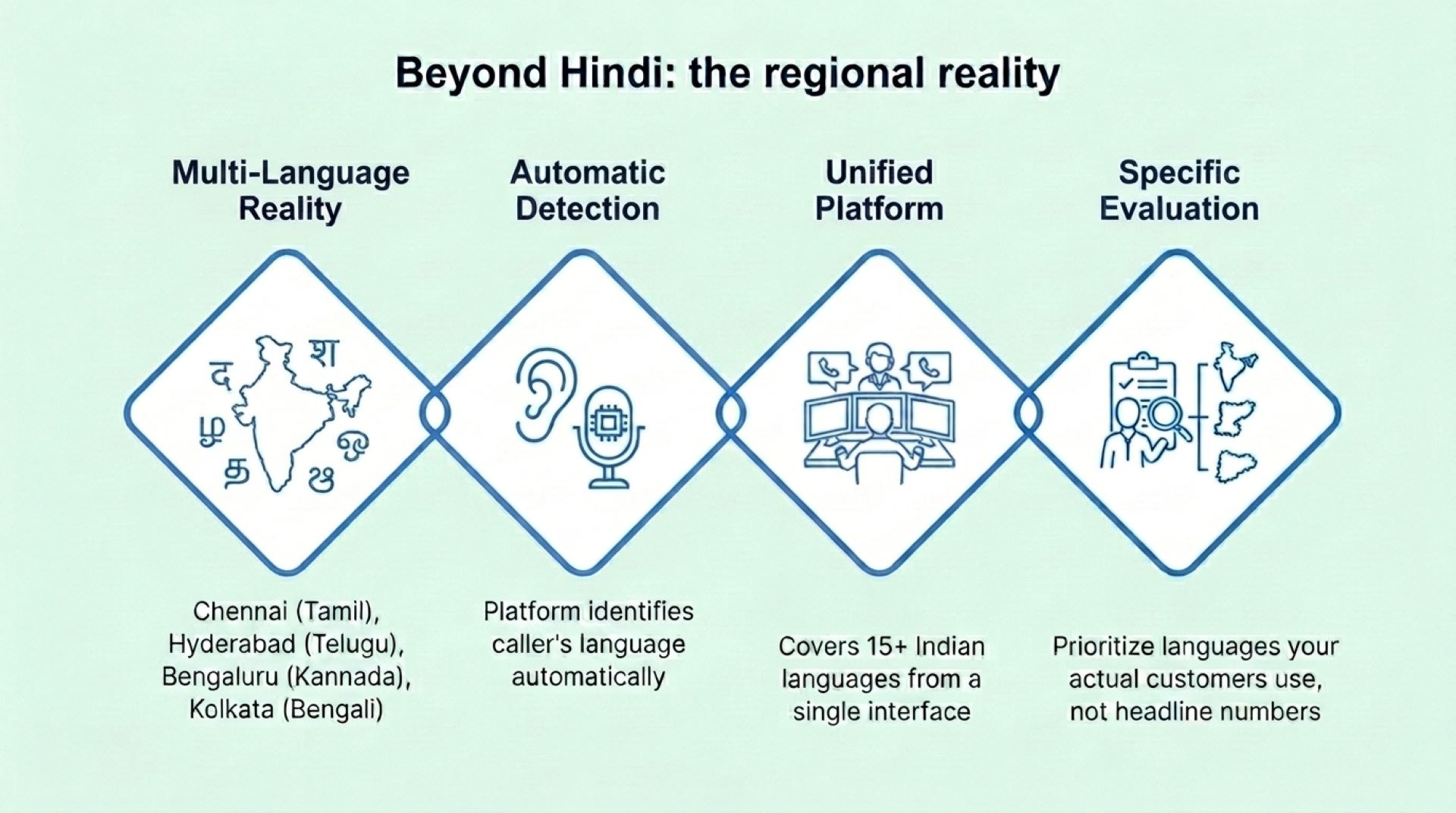
Hindi gets you a long way, but India is genuinely multilingual. A customer in Chennai expects Tamil; one in Hyderabad, Telugu; in Bengaluru, Kannada; in Kolkata, Bengali. The strongest platforms cover 15+ Indian languages and pick up the caller's language on their own, so you aren't running a separate agent for every state. If you operate across regions, ask about the specific languages your customers actually use, not just the headline number.
Automatic language detection is the feature that makes this practical. Instead of asking the caller to choose a language from a menu, a good regional language voice AI hears the first sentence, identifies the language, and continues in it. The same agent can greet one caller in Hindi and the next in Marathi without any change on your side. For a business running a single national campaign, that is the difference between one configuration and twelve.
A word of caution on the "headline number," though. Supporting fifteen languages on a slide is not the same as supporting your fifteen languages well. Quality varies language by language even within the same product. Punjabi or Gujarati may sound excellent while a lower-resource language sounds stilted. The fix is the same buyer's test as before: have the vendor run your real script in each language that actually matters to your customer base, and judge each one on its own.
A quick reality check on quality
Hindi voice AI has come a long way, but quality still swings wildly from one vendor to the next. Older or cheaper systems read Hindi flat and syllable by syllable, garble English words dropped into a Hindi sentence, and pause a beat too long before replying. Customers clock it instantly, and trust evaporates. The newer audio-native models sound far more natural: smoother intonation, names and numbers pronounced right, and quick, confident turn-taking. When you evaluate, push your own messy real-world Hinglish through it and judge it the way your customers will, in the first ten seconds.
Latency deserves special attention because it is the silent killer of natural conversation. When the gap between a caller finishing and the agent replying stretches past roughly 300 milliseconds, the call starts to feel laggy, callers talk over the bot, and the whole exchange degrades. Phone audio is unforgiving here in a way that web demos often hide, so always test over a real call on a real Indian mobile network, not a polished recording on a laptop. A pristine studio clip tells you almost nothing about how the agent will behave on a patchy 4G line in a busy market.
Compliance and connectivity in India
Two things separate a Hindi voice agent you can run at scale from a demo that gets you into trouble: regulation and call delivery. On the regulatory side, commercial calling in India is governed by TRAI's TCCCPR rules. That means DLT (telemarketer) registration, scrubbing numbers against DND, capturing consent, and keeping promotional calls inside the 9am-9pm window. These are not optional, and the safest path is a platform where the guardrails are built in rather than left to you to remember. Our TRAI compliance guide walks through the specifics, and there are data-protection duties under the DPDP framework to layer on top.
Connectivity is the other half. A voice agent is only as good as the line it rides on. Clean carrier connectivity across Jio, Airtel, BSNL and Vi, the ability to use local numbers so calls don't look like spam, and stable audio quality on Indian mobile networks all directly affect pickup rates and whether the conversation even gets a chance to start. When you compare vendors, treat carrier integration and number provisioning as first-class questions, not afterthoughts.
The bottom line
A Hindi voice agent only earns its place if it handles real Hinglish naturally. Judge it on your own scripts before you commit to anything.
Check five things before you sign. Voice quality on real Hinglish, not clean Hindi paragraphs. Latency under about 300ms. Clean carrier connectivity over Jio, Airtel, BSNL and Vi with local numbers. Compliance, where DND scrubbing, the 9am-9pm window and DLT registration are non-negotiable (see our TRAI compliance guide). And data ownership for your recordings and transcripts. 9278.io runs on a single audio-native model with native voices across Hindi, Hinglish and 15+ Indian languages, dialect auto-switching, sub-300ms latency, and Indian carrier connectivity built in. You can hear it in Hindi or build your first agent.
Ready to put a voice agent on your phones?
Native-audio AI agents in 15+ Indian languages, on Jio/Airtel/BSNL/Vi, live in hours.
Build your first agent